Aquaculture facilities depend on carefully managed water movement, from incoming seawater and freshwater supply to filtration loops, tank drainage, and automated feeding systems. Pipework must withstand continuous exposure to moisture, salts, disinfectants, and treatment chemicals while maintaining stable flow conditions that support fish health. PVC extrusions offer a practical option for many of these applications because their performance can be tailored through material formulation, wall design, and connection specifications.
However, suitability depends on the actual water chemistry, operating pressure, temperature, and applicable safety requirements. DEKUMA, a manufacturer of plastic pipe extrusion equipment, operates in the processing sector that supports the production of polymer piping used across industrial and agricultural infrastructure.
Corrosion Resistance in Seawater and Chemical Environments
Marine aquaculture exposes pipe networks to chloride-rich water that can accelerate corrosion in susceptible metals. PVC does not rust like carbon steel, making it useful for many seawater distribution and drainage applications. Its chemical resistance, however, is not universal: compatibility depends on the PVC formulation, chemical concentration, temperature, exposure duration, and mechanical stress. Cleaning agents, oxidising disinfectants, and specialised water treatments should be checked against material compatibility data before a system is specified.
Recirculating aquaculture systems (RAS) create a different set of operating conditions. Water repeatedly passes through mechanical filters, biofilters, pumps, oxygenation equipment, and treatment units, so piping must tolerate continuous circulation and occasional cleaning procedures. A suitable material should retain its mechanical properties under the expected operating conditions, while joints and valves must be compatible with the same water chemistry. Particular attention is needed at pump outlets, bends, and transitions, where pressure fluctuations or vibration can add stress.
The surrounding environment also affects installation choices. Outdoor pipework may experience ultraviolet exposure, temperature changes, impact, and support loads, whereas submerged lines face buoyancy and movement concerns. Engineers should assess the complete installation rather than rely on corrosion resistance alone. Proper support spacing, suitable joint design, and allowance for thermal expansion help reduce mechanical problems over the service life of the network.
Smooth Bore Design and Fish Welfare
Water quality in aquaculture depends on more than filtration equipment. Pipe geometry influences flow resistance, deposition, and the ease with which biofilms or organic residues can accumulate. A smooth internal surface can reduce friction compared with a rougher passage of equivalent dimensions, although actual performance also depends on pipe diameter, water velocity, bends, fittings, and surface condition. Excessive turbulence or poorly designed transitions can disturb flow patterns and create maintenance challenges.
Fish welfare introduces additional considerations when designing water delivery and circulation. Pumps, elbows, reducers, and outlet arrangements can produce shear or turbulence that may affect fish, particularly in systems handling delicate or juvenile species. Pipe selection must be considered alongside hydraulic design, including appropriate velocities, flow distribution, oxygen delivery, and the avoidance of stagnant zones. The objective is to maintain water quality and suitable circulation without creating unnecessary stress within tanks or raceways.
Surface cleanliness is also important in systems where nutrients, feed residues, and biological material circulate through the water. Accessible inspection points, drainable layouts, and cleaning procedures help prevent deposits from building up in low-flow sections. Although smooth pipe walls can assist maintenance, they do not prevent biofilm formation. Regular inspection and a cleaning regime compatible with the pipe material remain necessary to maintain stable operating conditions.
Material Safety and Pipe Manufacturing Quality
Materials in contact with aquaculture water should be assessed for their intended use, particularly where fish are raised for human consumption. Buyers may need evidence relating to migration, extractables, formulation, or other requirements specified by the relevant market and application. Food-contact certification should not be assumed simply because a pipe is made from PVC; the exact product, formulation, certification scope, and intended conditions of use must be verified. Drinking-water approvals may also differ from requirements for aquaculture or food-processing environments.
Manufacturing consistency affects dimensional accuracy and the reliability of joints. Variations in outside diameter, wall thickness, or surface finish can complicate assembly and affect pressure performance. A PVC pipe manufacturing machine must process the selected compound within a suitable temperature and shear range, while maintaining stable output and consistent forming conditions. Product qualification should include checks of dimensions, pressure capability, joint compatibility, and other properties relevant to the installation.
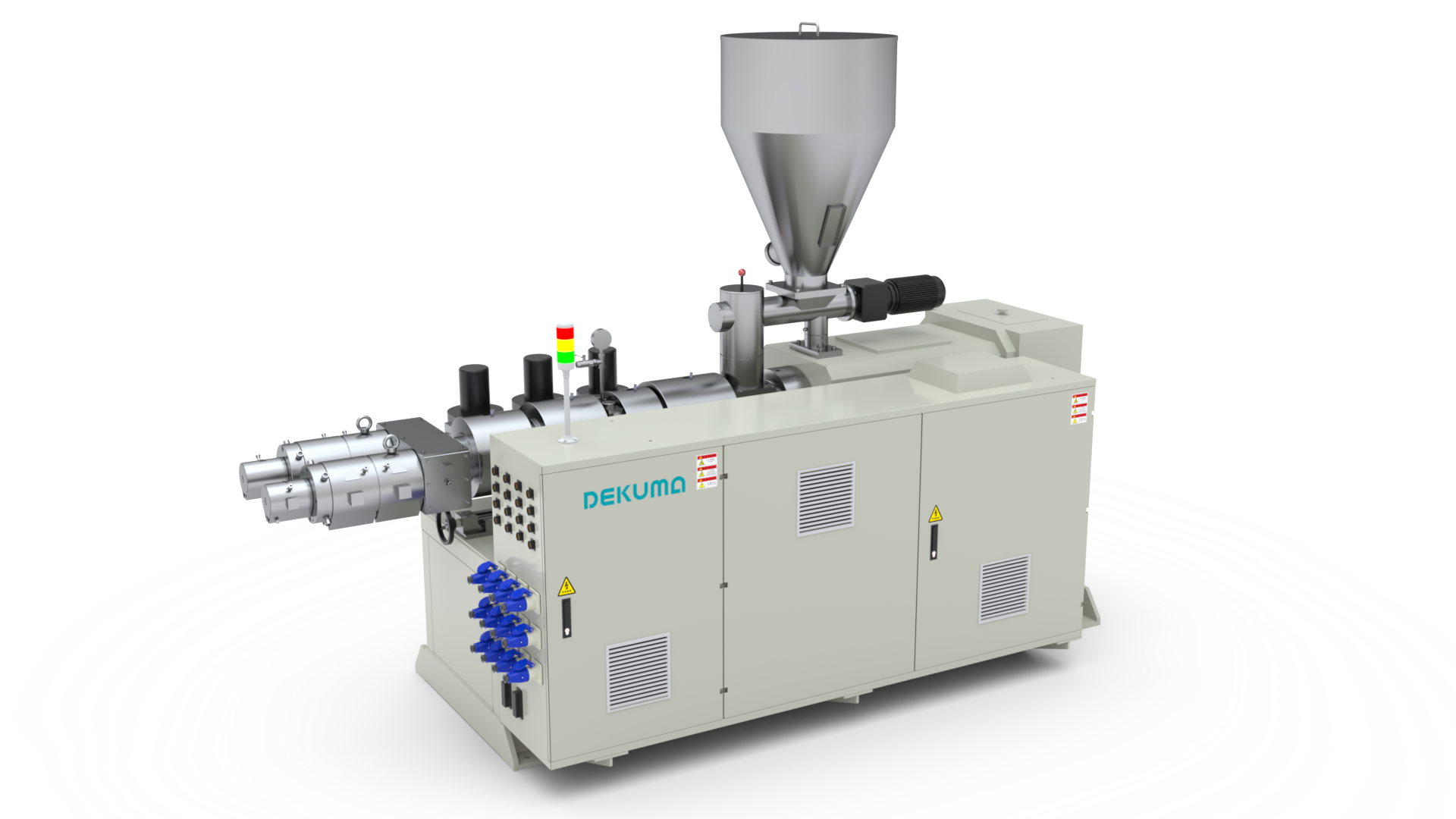
Equipment design can influence the way PVC compounds are processed. DEKUMA specifies PVC pipe extrusion equipment using conical twin-screw extruders designed for PVC-U and PVC-M pipes across applications such as water supply, drainage, irrigation, ventilation, wire protection, industrial services, and gas transportation. Its extrusion die-head design features spacious, smooth flow channels intended to reduce pressure drop and melt temperature, along with ceramic heaters and a surface-finish focus.
Conclusion
Modern aquaculture requires pipe systems that support reliable water circulation, manageable cleaning, and stable water quality under demanding environmental conditions. PVC extrusions can serve many seawater supply, recirculation, drainage, and feeding-related applications, provided chemical compatibility, mechanical performance, and material approvals are verified for the specific use. Smooth internal surfaces may assist hydraulic efficiency and maintenance, but fish welfare also depends on system layout, flow velocity, and water treatment.
DEKUMA supplies extrusion equipment for PVC pipe production, while the suitability of each finished product rests on its formulation, manufacturing controls, and documented testing. Thoughtful specification from material selection through routine inspection helps aquaculture operators build infrastructure that supports dependable production and animal welfare.