An injection-moulding press and a warehouse ceiling fan appear, at first sight, to have little in common. One demands pressure changes within a fraction of a second, while the other turns slowly for hours at a time.
Both, however, can be driven through closed-loop control, and VFD manufacturers increasingly offer dedicated products for each. Whether feedback really makes a Hydraulic Servo system and a fan drive members of the same family depends on what is measured, how quickly the loop must react, and what happens when the measurement is lost.
What a Feedback Loop Actually Does
A servo pump controller asks for a pressure, reads the actual pressure from a sensor and corrects the motor speed until the two agree; that sequence is a closed loop. In a drive, the command might equally be a speed, a flow or a temperature, and the measurement might come from an encoder, a transducer or a process sensor. Open-loop control, by contrast, sets the output and trusts the system to follow, which works well when the load is predictable.
How useful a loop is depends on the speed of the measurement, the accuracy of the sensor and the bandwidth of the controller. A loop that reacts too slowly cannot correct fast disturbances, while one tuned too aggressively begins to oscillate. A fan VFD and a servo pump drive sit at opposite ends of this range, which is why one principle produces very different hardware.
Pressure and Flow in an Injection-Moulding Press
Injection moulding cycles through injection, holding, cooling and mould opening within seconds, and each phase needs a different combination of oil flow and pressure. A conventional fixed-speed pump runs continuously and wastes energy over relief valves whenever demand is low.
A servo-driven pump instead changes motor speed and torque to deliver the flow and pressure that each phase requires, and nothing more. Energy use falls as a result, because the motor slows or stops during cooling and holding phases when little flow is needed.
FRECON’s HS580 Hydraulic Servo drive works on this principle with a synchronous servo motor and two feedback paths: a rotary encoder for flow and a pressure sensor for pressure.
Both quantities are controlled in closed loop, and the company describes the result as fast pressure rise, high regulation accuracy and small overpressure. The drive supports parallel control of up to four pumps, has a built-in braking unit up to 110 kW, and offers built-in CAN and RS485 communication with EtherCAT as an option.
Why Fan Loads Behave Differently
Fan loads follow different physics. Torque rises with the square of speed, the rotating mass is large, and the process, usually air movement or cooling, changes slowly. Most fans therefore run without a speed sensor at all, and where a loop is used, it closes around room temperature, duct pressure or air quality rather than shaft position, with response times measured in seconds.
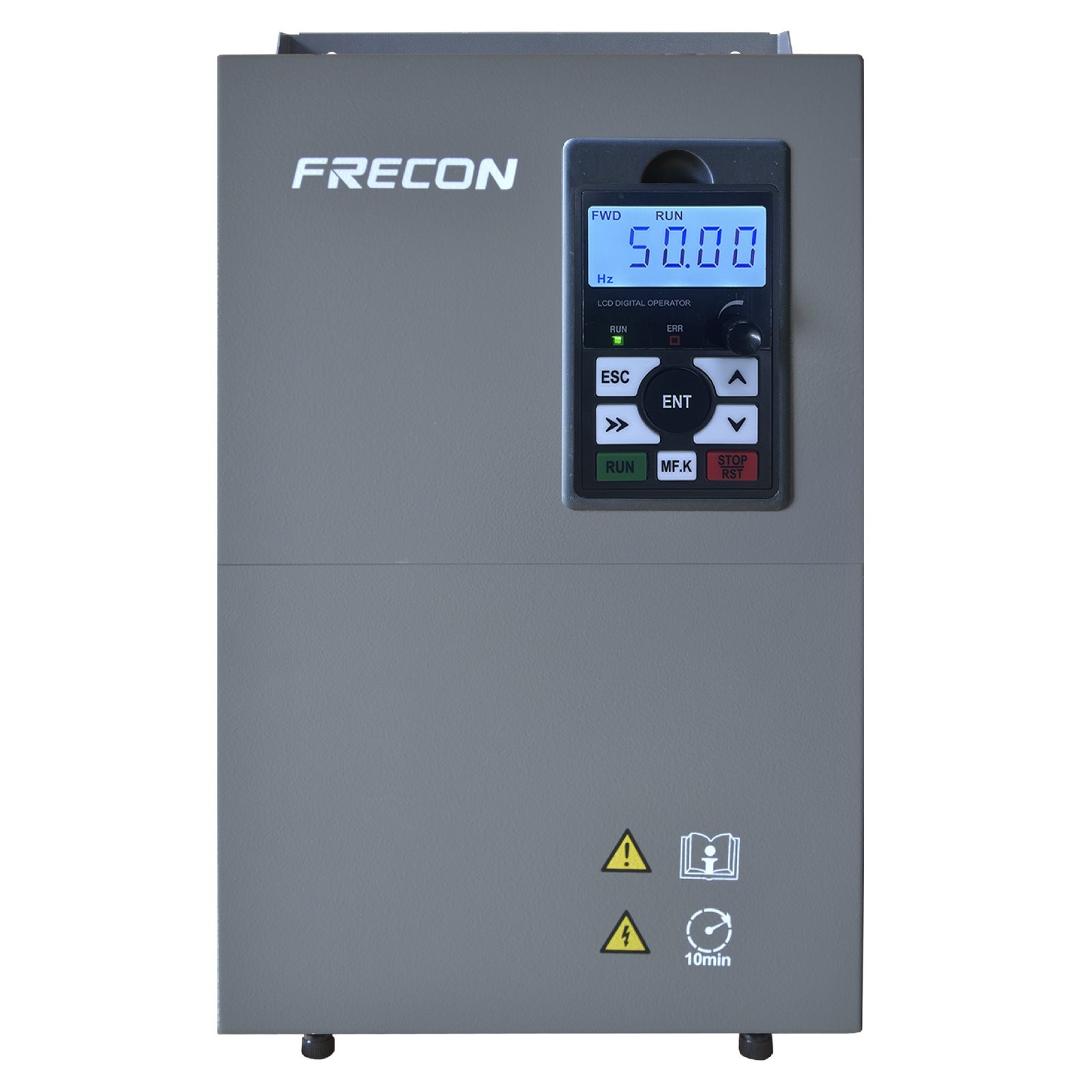
The real control problems lie elsewhere: starting into a fan that is already windmilling, avoiding resonant speeds and keeping installation simple. FRECON’s IF150 industrial fan all-in-one inverter addresses the last point with an integrated display, a digital speed knob and start/stop buttons, waterproof connectors with top cable entry, and support for both synchronous and asynchronous motors, so no separate control cabinet is needed.
Its ratings, the single-phase 220V IF150-2S-1.5B and the three-phase 380V IF150-4T-1.5B and IF150-4T-2.2B, suit a fan VFD serving ventilation in factories, warehouses and stadiums rather than high-dynamic machinery. The application asks for simplicity, and that demand is one reason VFD manufacturers develop dedicated fan products instead of a general drive with every function switched on.
Shared Principle, Separate Engineering
Feedback does unify the two machines at the level of principle. Both compare a target with a measurement, both rely on the drive to adjust motor speed and torque, and both can report to a higher-level controller. A Hydraulic Servo system and a fan VFD also share the same power-electronic foundation of rectifier, DC bus and inverter bridge, so VFD manufacturers can build both from a common technology base.
The differences remain decisive in practice. The servo pump needs fast pressure response, precise feedback and coordinated control of several pumps, whereas the fan drive needs dependable starting, minimal wiring and tolerance of long running hours.
FRECON‘s dedicated-drive line keeps these needs in separate products, the HS580 for injection moulding and the IF150 for industrial fans, alongside drives for elevators, water supply, construction hoists and textile machinery.
Loss of measurement exposes the gap most sharply. If the pressure sensor on a servo pump fails, the loop can push the pump towards maximum pressure, so the system depends on sensor monitoring and on the hydraulic relief valve as a final barrier. A fan whose temperature sensor fails, by contrast, can fall back to a fixed speed with little consequence beyond a less comfortable room.
So the honest answer is partial. Treating the two as interchangeable would overload the fan with functions it never uses and leave the press short of the response it needs. Closed-loop feedback gives both machines a common language, yet each needs a different vocabulary, and the hardware follows the vocabulary rather than the language.